Every real estate portfolio contains assets that look profitable on paper but conceal engineering risks capable of rewriting the investment’s entire feasibility. A developer who closes an acquisition without an independent risk assessment converts opportunity into an open-ended financial liability, because structural defects do not appear in price lists or sales presentations.
Engineering risk assessment is not a procedural formality added to a deal file. It is a decision-making tool that determines the true profit margin and protects the company against subsequent legal claims. On this basis, Inspectex has prepared this technical guide for investment and real estate development teams who need reliable data, not visual impressions, when making their decisions.
What Is Risk Assessment in the Context of Real Estate and Buildings?
A quick visual walkthrough may reassure a project manager on a first site visit, but it cannot account for risks buried inside concrete, behind suspended ceilings, or within concealed installations.
Defining Risk Assessment and Its Importance in the Saudi Real Estate Sector
Risk assessment in engineering inspection is a systematic methodology for identifying latent defects in a building, analyzing the likelihood of their progression, and classifying them according to their impact on investment value, operational obligations, or the company’s legal standing. The final output is not simply a description of the current condition; it is a complete risk map that enables an investment team to price the asset accurately and negotiate from a position of knowledge rather than assumption.
In the Saudi market, particularly in Riyadh and Jeddah, where the majority of development and acquisition transactions are concentrated, the engineering information gap between seller and buyer has become one of the highest sources of loss in uninspected deals. Companies that embed risk assessment into their standard procedures before any closing enjoy a financial and legal protection margin that companies who defer this step simply do not have.
What Are the Most Critical Structural and Property Risks That Must Be Identified?
Engineering risks across real estate portfolios are not evenly distributed. Understanding the nature of each category determines which specializations are deployed in the field team and which advanced equipment is brought to the site.
Structural Risks: Cracks, Foundations, and Load-Bearing Walls
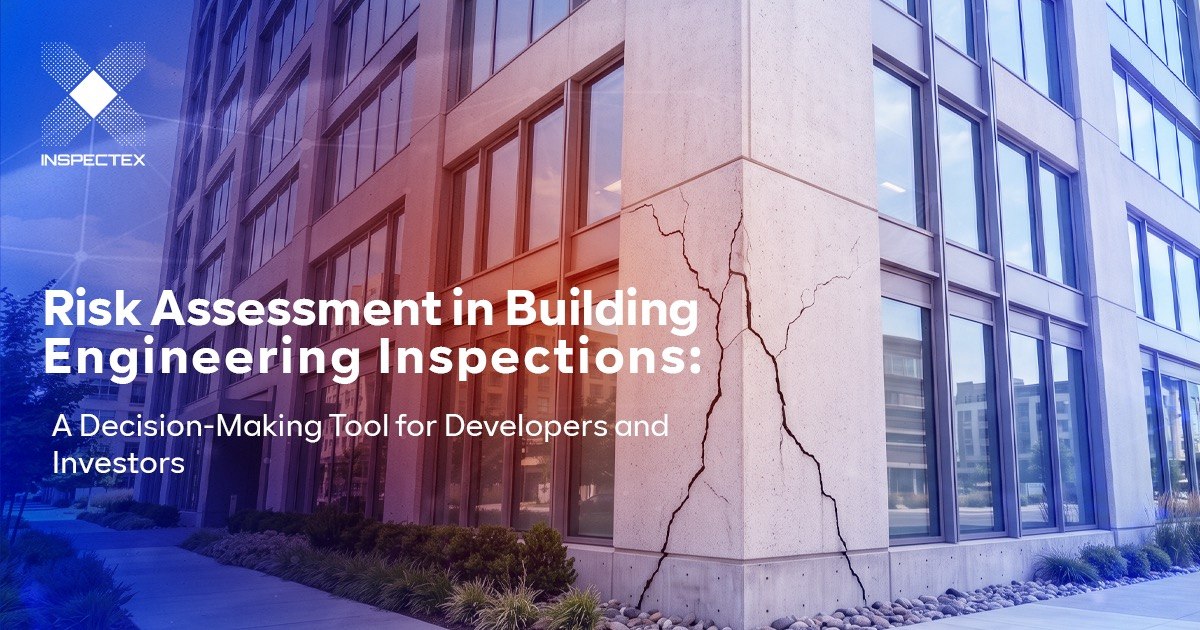
Identifying structural risks is the primary priority in any inspection of a commercial asset or multi-story building. Cracks in load-bearing walls, columns, or slabs may indicate foundation settlement or accumulated structural stress, both of which directly affect asset valuation and the cost of development or rehabilitation. A developer who discovers these issues after acquisition pays for them twice: the cost of repair on one side, and disruption to the project timeline on the other.
Mechanical, Electrical, and Concealed Plumbing System Risks
Concealed systems generate the most post-acquisition disputes, because they do not appear in standard site walkthroughs and are not always disclosed by the seller. Electrical installations that fail to meet Saudi Building Code requirements mean a full rewiring at the buyer’s expense. Deteriorated plumbing networks or pipework installed with non-compliant materials lead to internal leaks that emerge during the operational phase and erode the asset’s yield. Accordingly, overlooking this entire category during the inspection phase is an error paid for during construction or operations.
Moisture, Water Leakage, and Thermal and Waterproofing Insulation Risks
Moisture ranks among the highest-impact risks to commercial asset value and the slowest to surface visibly. Accumulated leaks cause corrosion of internal reinforcement, salt deposits on facades, and gradual deterioration of the structural system. For this reason, waterproofing and thermal insulation inspection forms a core pillar of any risk assessment process for commercial or residential assets within an investment portfolio, as it reveals cumulative deterioration that only becomes visible once the damage has widened and remediation costs have escalated significantly.
Building Compliance Risks with the Saudi Building Code SBC
The Saudi Building Code is a binding legal and technical reference. Non-compliance exposes the company to operational and licensing complications when modifying, re-leasing, or selling the asset. Buildings that predate the Code or were constructed under insufficient oversight may require extensive interventions to achieve full compliance, and these interventions must be factored into the actual feasibility analysis before any deal closes, not after.
What Are the Five Elements of Risk Assessment in Engineering Inspection?
The professional methodology for risk assessment is not a personal judgment call. It is a scientific framework that follows specific, sequential steps and does not yield its full output unless all of them are completed.
Hazard Identification: What Should Be Investigated in the Building?
Hazard identification is the starting point: the systematic mapping of every element in the building that may pose a risk to structural performance, operational continuity, or the financial value of the asset. The steps of risk assessment at this stage rely on a methodical field inspection carried out room by room and space by space, combined with a review of the building’s documents and plans before the site visit, to build a preliminary picture of where risk may concentrate.
Risk Analysis: Likelihood of Occurrence and Level of Structural Impact
Analysis converts identified defects into quantified data. Each issue is assigned an estimated probability of progression and a level of financial or structural impact if left unaddressed. The investment team uses this analysis to price the asset precisely or to build cost scenarios within a feasibility study. This is precisely where a formal safety assessment earns its value, as it transforms field observations into figures that hold up in board-level reviews and due diligence documentation.
Risk Classification: High, Medium, and Low, and How to Read the Results
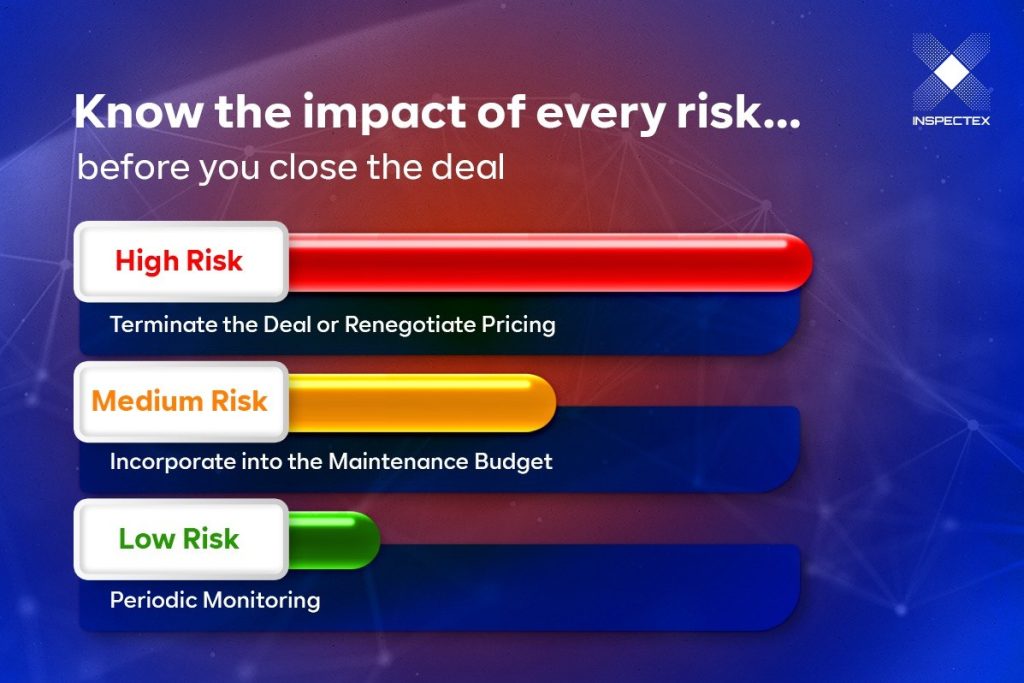
Classification produces a prioritized list ready for immediate action. High risks either require resolution before the deal closes or an adjustment to the pricing structure that reflects the cost of intervention. Medium risks are scheduled within a maintenance and development plan with defined timelines. Risk assessment examples at this stage take the form of a report that specifies clearly what is to be negotiated on price, what enters the rehabilitation budget, and what is monitored periodically during the operational phase. A structured risk assessment matrix within the report gives the investment team a defensible framework for every decision that follows.
Risk Treatment: Repair, Renegotiate, or Reject
Each risk calls for a treatment path suited to its nature. Some are resolved by making repair a pre-closing condition. Others serve as leverage for repricing the asset by the estimated intervention cost. In limited cases, a risk may reach a threshold where reconsidering the entire deal’s feasibility is the soundest financial decision. Managing risk assessment this way gives the investment team the initiative in any negotiation rather than discovering problems after the fact.
Risk Documentation: The Certified Engineering Report and Its Legal Standing
Documentation is the permanent institutional safeguard. A certified engineering report built on numerical findings, field photography, and verified recommendations constitutes a legal document that can be cited in disputes with sellers, contractors, or regulatory authorities. Without formal, certified documentation, managing risk assessment amounts to nothing more than verbal observations with no legal standing in any subsequent proceeding.
Risk Assessment Examples from Engineering Inspection Cases in Saudi Buildings
Real field examples are the clearest demonstration of the difference between an asset that appears acceptable and one that is engineering-verified by a certified report.
Example One: Multi-Story Commercial Building in Riyadh. The risk assessment process during the acquisition phase revealed differential settlement in one corner of the foundation due to soil variability. Classification: high risk requiring structural intervention. Risk treatment led to repricing the asset with a discount equivalent to the estimated reinforcement cost before the deal closed, shielding the portfolio from a financial liability not reflected in the original budget.
Example Two: Residential Complex Offered for Acquisition in Jeddah. Field inspection identified a plumbing network installed with pipes that failed to meet Saudi specifications, alongside concealed leaks behind walls in multiple units. The danger of these leaks lies in their cumulative and invisible effect on structural integrity: continuous water infiltration corrodes steel reinforcement and degrades concrete strength over time, converting a plumbing defect into a serious structural problem that demands extensive and costly remediation. This is a practical risk assessment example of how a single system failure cascades into a portfolio-level exposure that would have substantially reduced the projected return on investment had it not been identified before closing.
Example Three: Administrative Building Under Conversion to Hotel Use in Riyadh. Hazard identification showed that existing electrical installations did not meet the load requirements of the intended use and lacked the protection systems mandated by the Saudi Building Code. Treatment: the full rewiring cost was incorporated into the conversion budget before the final financial feasibility was approved, preserving the project’s financial model from a post-commitment surprise.
Managing Property Risk Assessment
Knowing what the risks are does not constitute managing them. Effective management of risk assessment requires a clear methodology and a team equipped with the tools and specializations to verify and document findings reliably.
Why Seller Disclosures and Internal Evaluations Are Never a Reliable Baseline
The seller is a direct party to the transaction and does not represent a neutral reference for assessing the asset’s condition. Relying on their disclosures exposes the company to feasibility gaps that only surface after acquisition. Equally, an internal evaluation without specialized equipment and an independent engineering team cannot detect what is concealed within structural systems. A building inspection conducted by an independent party is the standard procedure that ensures decisions rest on unbiased data rather than commercially motivated disclosures.
Required Qualifications for an Engineering Risk Assessment Team
The risk assessment team relied upon by institutional companies must combine genuine field experience in commercial projects, thorough familiarity with Saudi Building Code requirements, and the capability to operate non-destructive testing equipment to detect what the naked eye cannot perceive. Beyond technical competence, the reliability of any report is further reinforced by an internal review mechanism that examines findings before final issuance, ensuring every recommendation can withstand scrutiny from any third party. For teams evaluating which inspection model fits their project scope, a site inspector with multi-discipline field coverage remains the benchmark for institutional-grade risk assessment.
The Role of the Three-Engineer Model: Civil, Electrical, and Mechanical
Comprehensive management of risk assessment requires multiple field specializations working simultaneously on the same asset. The civil engineer evaluates the structural frame, foundations, and load-bearing elements. The electrical engineer inspects installations, distribution panels, and their level of Code compliance. The mechanical engineer covers plumbing networks, HVAC systems, and moisture zones. Three specializations on site simultaneously produce a more complete picture with fewer gaps than any single engineer, regardless of the breadth of their experience. A property inspection structured around this three-engineer model delivers the technical coverage that investment committees accept as a credible basis for decision-making.
Inspectex for Engineering Risk Assessment to International Standards in the Saudi Market
The differentiator between inspection firms is not the trade name. It is the depth of the methodology, the precision of the documentation, and the report’s ability to withstand any technical or legal review.
How Does Inspectex Classify Risks Within Its Certified Engineering Reports?
Inspectex begins the risk assessment process by gathering the building’s documents and plans before the field inspection, then deploys a specialized three-engineer team to cover each discipline separately within a strict review methodology. Each identified defect is classified by financial impact and structural likelihood, with an estimated remediation cost incorporated directly into the report. As a result, the investment team receives a pricing tool ready for immediate use in negotiation sessions. The safety risk assessment embedded in every Inspectex report follows the Saudi Building Code as its binding technical reference, ensuring that every classification and recommendation carries regulatory weight.
Inspection Using NDT, GPR, and 3D Laser Scanning Technologies
Inspectex deploys precision instruments and advanced non-destructive testing techniques that enable the engineering team to detect internal voids in concrete, identify reinforcement pathways, and locate concealed moisture zones without opening walls or ceilings. This level of detection reduces the unknown in any acquisition decision and enables a formal safety assessment of structural conditions at a precision level that renders cost assumptions based on guesswork unnecessary.
The Inspectex Report: A Certified Engineering Document That Strengthens Your Company’s Position in Any Dispute or Review
The report is not written by the field inspector and is issued directly. It passes through an analysis team, a recommendations team, and a technical director who validates quality before delivery. It does not represent a point-in-time document but an engineering reference retrievable at any dispute, resale, or institutional review, with data retained for a minimum of ten years.
The certified engineering report issued by Inspectex is delivered in PDF format and includes:
- Comprehensive system assessment: full coverage of architectural, structural, electrical, and mechanical systems within a unified, integrated methodology.
- More than 1,000 documented inspection points: spanning from the roof to the foundations without omitting any space or service zone.
- Field photography and equipment findings: visual documentation of all inspected elements alongside results from advanced non-destructive testing techniques including thermal detection.
- Actionable engineering recommendations: structured tables describing each identified issue and specifying the recommended remediation method in line with Saudi Building Code requirements.
- Quantity survey and estimated repair costs: an actual survey of quantities requiring treatment, paired with a financial estimate based on prevailing market rates that the investment team can incorporate directly into the acquisition budget or use as a basis for price negotiation.
Frequently Asked Questions About Risk Assessment in Buildings
How Is Risk Assessment Conducted in Engineering Property Inspection?
It begins with a review of building documents and plans, followed by a systematic field inspection by a specialized team. Each defect is analyzed for its probability of progression and financial impact, then classified in a certified report that includes estimated costs and prioritized intervention recommendations.
What Are the Five Elements of a Risk Assessment?
Hazard identification, risk analysis, risk classification, risk treatment, and risk documentation. Each element builds on the previous one. The final report converts these stages into a decision tool ready for immediate use in negotiation or financial planning, with the risk assessment matrix providing a structured framework across the classification and documentation stages.
What Are the Five Steps of the Risk Assessment Process?
Gathering documents and plans, conducting field inspection with advanced equipment and non-destructive testing techniques, analyzing collected data, classifying risks by impact and likelihood, and issuing a documented report with ranked, actionable recommendations.
When Is Risk Assessment Essential for Companies and Developers?
Before any acquisition or entry into a real estate partnership, when reassessing an existing portfolio, and before converting an asset from one use to another. Each of these moments demands reliable engineering data rather than visual estimates or seller representations.
Before Any Acquisition Decision, Commission a Risk Assessment Report from Inspectex
Assets that appear promising on paper may conceal engineering risks that rewrite the financial feasibility entirely. Risk assessment is not an additional line item in the deal file. It is the tool that defines the true profit margin and insulates the company from unaccounted liabilities. The five steps of risk assessment, identification, analysis, classification, treatment, and documentation convert an unknown asset into a verified one on which defensible investment decisions can be built and audited.
Inspectex delivers this methodology in Riyadh and Jeddah through a specialized three-engineer team, using precision instruments and non-destructive testing techniques, with a report that passes through multiple review stages before final approval.
Contact Inspectex today and obtain your engineering risk assessment report before closing any deal.

Leave a Reply