
Medical facilities are not standard commercial buildings; they are highly complex, life-saving infrastructures where a minor electromechanical failure can have immediate, fatal consequences. Whether it is an unexpected power drop in an intensive care unit (ICU) or a loss of negative pressure in an airborne infection isolation room, the stakes in healthcare environments are absolute. Acquiring or maintaining a healthcare facility requires rigorous, undeniable technical validation. At Inspectex, our professional assessment evaluates the true operational condition of your Hospital Inspection. This guide outlines the critical engineering protocols our specialized engineers utilize to ensure maximum efficiency, zero unscheduled downtime, and complete compliance with the Saudi Building Code (SBC) and national health regulations.
What Is a Healthcare Facility Evaluation?
A clinical engineering audit must be defined through a strictly technical and operational lens.
Defining the Medical Center Audit and Its Core Purpose
A healthcare facility evaluation is a systematic, non-destructive assessment of a medical property’s structural integrity, electromechanical networks, and specialized life-safety systems. The core purpose goes far beyond listing visible surface defects; it is meticulously designed to perform a deep root-cause analysis of the building’s critical infrastructure. Specialized engineers utilize advanced diagnostic data to assess heavy machinery alignment, systemic electrical stability, and sterile environmental controls. Every phase of an inspection in a hospital focuses on sustaining life-critical operations without interruption.
Types of Clinical Assessment Services
Specialized engineering companies deploy distinct assessment protocols:
- Pre-Commissioning Audit: Conducted before opening a new ward to ensure adherence to medical engineering schematics.
- Operational Safety Assessment: Focuses on the current degradation of civil materials and aging electromechanical systems.
- Preventative Maintenance Evaluations: Scheduled audits to monitor systemic aging in critical areas like operating theaters.
- Document Review and Engineering Documentation: Every inspection systematically includes a comprehensive document review of the facility’s existing schematics. Furthermore, for older buildings that have undergone unrecorded modifications over the years, our team provides complete “As-Built” documentation covering four core disciplines: Architectural, Structural, Mechanical, and Electrical. This ensures that every undocumented alteration is meticulously mapped and officially recorded for future compliance and maintenance.
Why Hospital Inspection Is Critical: Safety, Risk, and Healthcare Protection
Securing a medical center requires a proactive approach to mitigate catastrophic structural failures and massive financial liabilities.
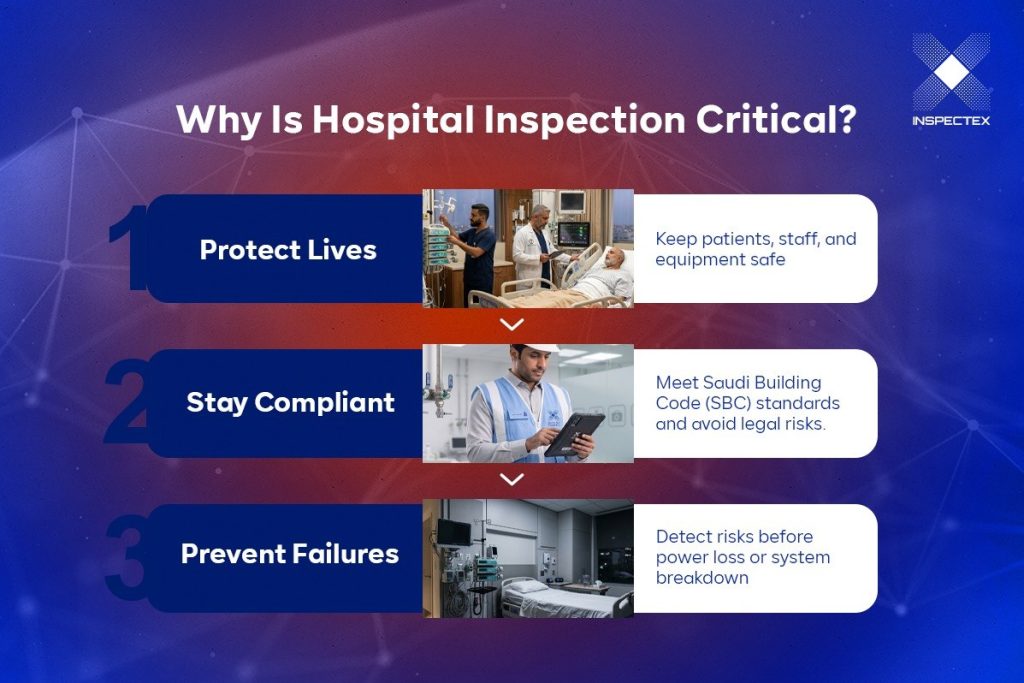
Protecting Patients, Staff, and Medical Infrastructure
The healthcare environment is inherently sensitive. Poorly executed heavy electrical wiring or unmonitored structural vibrations often remain completely hidden until a critical failure occurs. A deeply technical audit eliminates concealed hazards – such as thermal arcing in main switchgears or micro-fractures in concrete slabs supporting heavy MRI machines – before they escalate into life-threatening safety incidents.
Ensuring Compliance with Saudi Health Regulations and Codes
Every medical unit must adhere strictly to the rigorous technical mandates of the Saudi Building Code (SBC) and the exacting safety regulations set by the Saudi Civil Defense. Verifying compliance ensures that the fire suppression networks are highly responsive, the structural load distribution is mathematically accurate, and the property meets all legal thresholds required for operational licensing.
Reducing Operational Risks and Healthcare Liabilities
In a medical setting, an unexpected power outage is an absolute emergency. Conducting a rigorous inspection in a hospital systematically identifies weak points in backup generators, Uninterruptible Power Supply (UPS) systems, and central medical gas pipelines. By isolating these vulnerabilities, healthcare administrators guarantee zero unscheduled downtime.
What a Comprehensive Infrastructure Audit Covers: Full Scope by Zone
The evaluation involves a highly structured engineering protocol divided into specialized disciplines.
Structural Assessment: Building Safety and Load-Bearing Systems
Specialized civil engineers analyze the building envelope for:
- Dynamic Load Endurance: Evaluating the slab’s response to heavy radiological equipment.
- Radiation Shielding: Inspecting lead-lined walls and doors in X-ray departments.
- Hygienic Surfaces: Measuring the leveling and chemical resistance of anti-microbial epoxy flooring.
Medical Equipment and Power Systems
A specialized electrical engineer conducts a thorough audit to prevent voltage drops:
- Isolated Power Systems (IPS): Testing medical IT systems in operating rooms against micro-shocks.
- Switchgear Diagnostics: Thermal scanning of Automatic Transfer Switches (ATS) for seamless generator transitions.
- Grounding: Measuring earth electrode resistance to dissipate massive electrical surges.
Mechanical Systems: HVAC and Ventilation (Air Quality Control)
A dedicated engineering evaluation assesses the supporting mechanical framework:
- Pressure Control: Verifying pressure differentials in Airborne Infection Isolation Rooms (AIIR).
- Air Changes Per Hour (ACH): Confirming critical zones meet mandatory air change rates.
- HEPA Filters: Assessing the sealing of High-Efficiency Particulate Air (HEPA) filters.
Water Systems and Infection Control Infrastructure
The mechanical engineering team focuses heavily on clinical fluid systems:
- Medical Gas Pipeline Systems (MGPS): Evaluating copper piping networks for oxygen and vacuum systems.
- Legionella Prevention: Inspecting central hot water boilers and cooling towers.
- Industrial Drainage: Verifying slopes and chemical resistance of laboratory drainage pipes.
How Inspectex Conducts a Hospital Inspection
Our methodology integrates multi-disciplinary engineering expertise with state-of-the-art diagnostic technology.
Specialized Testing Using Advanced Tools
Our specialized engineering teams deploy an extensive arsenal of advanced, non-destructive diagnostic instruments. Every expert utilizes the specific high-precision tools designated for their particular engineering discipline. These include advanced thermal scanning technology, high-precision electrical measurement units, digital airflow sensing systems, and many other sophisticated devices designed to provide undeniable technical evidence without causing any physical damage to the property.
Multi-Discipline Engineering Team Approach
At Inspectex, every full assessment is conducted by a professional engineering team specializing in the following disciplines: Civil/Structural Engineering, Electrical Engineering, and Mechanical Engineering. Our experts meticulously evaluate more than 1,000 distinct inspection points during every property assessment. By integrating these engineering specialties, we ensure high technical accuracy and prevent cross-disciplinary oversights, providing a comprehensive diagnostic for every unit.
Comprehensive Inspection Reports for Compliance and Certification
Following the field audit, the collected data undergoes rigorous office-based analysis. The report passes through four strict stages of auditing involving an inspection team, an analysis team, a recommendations team, and final approval by a senior technical manager.
Within 3 to 7 working days, the healthcare administration receives a comprehensive technical report delivered in PDF format. This document utilizes an objective grading system (ranging from A to F) to classify technical defects based on their severity and impact on the property’s lifecycle. Every report provides undeniable thermal and photographic evidence, alongside binding engineering recommendations that are strictly grounded in the Saudi Building Code (SBC).
Furthermore, as an engineering entity accredited by the Saudi Standards, Metrology and Quality Organization (SASO) and the Saudi Accreditation Center (SAAC), we ensure that every finding holds full official legitimacy in formal negotiations. To guarantee long-term asset security, all engineering records and reports are securely archived for a minimum of 10 years, providing a reliable technical reference for future facility management.
When Should You Conduct an Engineering Assessment?
Before Commissioning, Renovation, or Accreditation
The optimal time for a thorough evaluation is before signing a handover contract for a newly constructed clinical wing, or right before applying for stringent national or international healthcare accreditations (such as CBAHI or JCI). Specialized engineers will uncover concealed electrical or HVAC defects, safeguarding your massive initial capital and ensuring your facility passes external reviews effortlessly.
After Safety Incidents or System Malfunction
Following any critical failure – such as a sudden short circuit in an intensive care ward or a catastrophic failure of a medical air compressor – an immediate engineering validation is technically mandatory. This reactive hospital room inspection deeply identifies the exact root cause of the failure, preventing it from ever recurring and immediately restoring full operational safety for patients and staff.
As Part of Routine Preventive Maintenance Programs
Clinical materials and mechanical systems naturally degrade over time due to severe thermal stress, continuous 24/7 operational wear, and frequent chemical sanitation. Scheduling a periodic inspection in a hospital allows specialized engineers to monitor this gradual degradation closely. This strategic intervention minimizes sudden machinery failures, reduces replacement costs, and significantly extends the lifecycle of the infrastructure.
Benefits of Professional Healthcare Facility Audits
Proactive technical intervention yields tangible, immediate benefits for the hospital owner and management board on both technical and financial levels.
Ensuring Compliance and Avoiding Regulatory Risk
Early detection ensures the absolute stability of the infrastructure supporting your most critical medical departments. It protects hyper-sensitive radiological and life-support equipment from premature degradation caused by irregular electrical frequencies or unseen structural shifts. Managing these structural and electromechanical issues proactively directly translates to continuous compliance with the Saudi Building Code (SBC), keeping the facility far away from regulatory fines or sudden operational shutdowns.
Protecting Operational Efficiency and Patient Safety
By incorporating rigorous engineering checks, healthcare facilities can significantly reduce the massive energy loss caused by utilizing worn-out electrical cables or inefficient HVAC chillers. Most importantly, resolving systemic structural faults provides absolute, uncompromising safety for the medical workforce and protects the entire structural envelope from catastrophic events such as electrical fires. This allows medical professionals to focus entirely on their primary mission: ensuring patients heal in a secure, technically optimized environment.
FAQs: Hospital Inspection in Saudi Arabia
What Is a Hospital Inspection?
It is a comprehensive engineering evaluation conducted exclusively by specialized engineers to assess the structural, electrical, and mechanical integrity of a healthcare facility using non-destructive diagnostics.
What Does a Hospital Inspection Cover?
The engineering audit encompasses a strict root-cause analysis of the structural framework, rigorous thermal testing of electrical panels, and a full assessment of medical HVAC and gas pipeline systems.
Can a Hospital Inspection Be Conducted Without Closing Operations?
Yes. By utilizing advanced thermal diagnostics and acoustic sensors, our specialized engineers can definitively pinpoint hidden anomalies without shutting down active patient-care zones.
How Long Does a Hospital Inspection Take?
A standard evaluation for a hospital typically takes from one day to several days of continuous, focused fieldwork. The exact timeframe depends heavily on the facility’s size, the number of clinical wards, and the overall complexity of its electromechanical infrastructure.
Partner with Inspectex for Certified Medical Facility Assessment
Safety and efficiency inside your healthcare center are the direct results of sound engineering decisions. At Inspectex, we provide elite technical precision to guarantee your medical facility operates at peak efficiency.
Do not leave the structural integrity of your healthcare investment to unqualified labor. Rely on a systematic engineering audit that analyzes, measures, and delivers exact technical recommendations.
Contact Inspectex today to schedule your comprehensive engineering assessment, available exclusively in Riyadh and Jeddah, and secure sustainable safety and zero downtime for your medical center.

Leave a Reply